
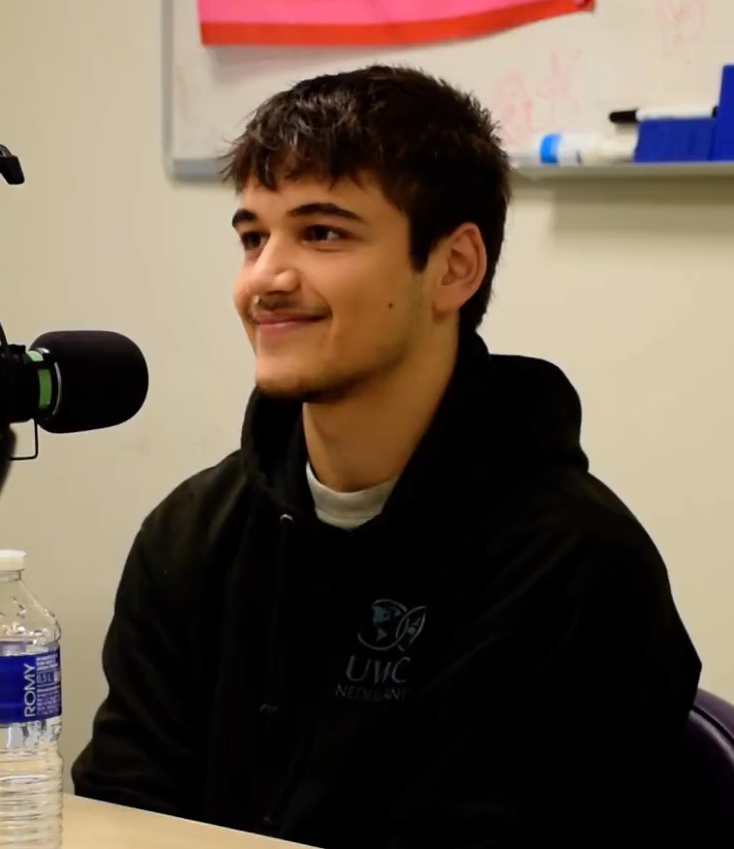
Regarding the upcoming elections, BaisWave and BaisMag interviewed different political candidates. This time, we met Thomas Karmarker from the NSC Party (The New Social Contract).
Gaia: Hi, I’m Gaia, and this is the Dutch Refresher. Welcome back! This is a project in collaboration with BaisMag and BaisWave, the radio and the magazine of our bachelor. Today we’re with Thomas Karmarker. Thomas, would you like to introduce yourself to our readers and listeners?
Thomas: Of course. Thank you for having me. I really appreciate to be given a platform to spread my message. I’m Thomas Karmarker, I’m 21 years old. I’m a third year student at Leiden University College studying Liberal Arts and Sciences, majoring in Economics, Governance and Development. This is the first time I’m doing anything related to politics, so it’s all a bit new to me. Why I wanted to get involved with politics is especially because of student housing and having the problem of finding a room – as so many students do in The Hague. I saw that student housing is an issue with students to be represented more, so that we can have more student housing troubles lessened.
Gaia: It’s a struggle. But how did it happen? How did you join the party? How does it work, did you have to apply somewhere?
Thomas: The thing is, because I couldn’t find a house, I lived with family friends from here and there for a while. And sometime, I was living with family friends, and the father was actually a member of parliament for the party the new social contract. And because I couldn’t find a room, I was looking into the policy. And one night I ranted at the dinner table, “Oh, this is ridiculous, that’s ridiculous!”, and he said, “if you really want to do something about it, join the team!”. And from conversations with him I knew that I could get behind a lot of the values of the new social contract, and so I said, “let me meet the team and see how it goes” and so here we are.
Gaia: That’s great! We’re going to talk a little bit about your party’s programme and then we have four points that we have built up by other fellow students, and then we see how we can address them. The first question is about good governance, which is one of the main points, especially the involvement of students in politics. So how does your party want to strengthen this connection between students and governance in The Hague?
Thomas: Good governance is a phrase that all parties kind of use right now. I would go as far as to say because the national party started to mention it, all parties kind of took it over. But how I see it on the local level is that I would preferably call it responsible government or reliable government, that is building specific mechanisms into government, how they are functioning and how they are operating, so that people can question how these decisions are being made. And what this looks like on a student level, I would say a single point of reference, that’s one of the biggest points in our programme, it’s a single bureau, so the problem of what’s happening in The Hague is that a lot of students are facing it as well, they come to some department and they’re like, “okay, I have this issue where should I go?”. And the department points them right to another department. Then they go to that department and they’re like, “where should I go?” “Oh, you should go to that department,” and people run in circles one to two months before they are actually helped. It’s a very simple solution to have this one bureau that is responsible for pointing you to the right department so that people know where they can end up at and that first bureau knows ‘okay, I will be responsible for this person getting helped in the end’. This way we can tweak the way the government functions so that people can feel represented and helped, and that they can feel that they can question who is making decisions, why they are making decisions.
Gaia: Okay, that sounds great. Another question I have is about social cohesion and specifically about culture. In the programme, you guys talk about culture as something that was supposed to be a luxury, and also, it’s something that can create community. We live in a city with an immense plurality of cultures. We can see through a lot of events, such as for example the embassy festival, there is a lot of culture. Cultures can create community, but also conflict. How is the party going to address this?
Thomas: The integration, and culture in general, is very important for the new social contract, because we believe that in order to be able to participate – participation and community is most important thing in order to make people feel trusted within the community that they want to work for, and for the community that they want to be a part of, and for that you need three things I would say: Breathing space and financial capacity. You need to be able to pay for yourself. Then you need to feel like the government supports you: you need to be able to question the function of the government, then thirdly, people need to get along. If you don’t get along, you don’t feel connected to wherever you live. And so, the NSC recognizes this and wants to be able to be a part of helping people connect to each other. A big part of that is connecting different organizations to help facilitate their interactions, facilitate their strengths so that they can help connect people in the neighbourhood and in The Hague in general. They want to support these cultural initiatives as well, because we recognize that it’s a very diverse city so it’s best to integrate as many people as possible, many cultures on top of experts, international students, connect them with Dutch students, Dutch experience, people who work in the city. So, we want to focus very heavily on that.
Gaia: Okay then, that’s great. Integration is definitely the move. The big question: housing crisis. The party program says that currently there are 20.000 habitants houses in The Hague, and the party program basically talks about just building new houses, but also making those houses inhabited. How are you planning to do that? Because usually, when houses are inhabited, there are issues in the structures of the building, the price, or there are issues with the legislation. Because that part is also very hard, so how are you going to address this?
Thomas: This is my favourite topic. I also wrote a lot of it about the programme. First of all, can you believe it? 20.000 houses. People are fighting for houses, and in the meantime, we have people speculating on houses, driving the prices up, houses stay empty, while we don’t have a house at all. That’s crazy, I cannot fathom it. Anyway, building new houses is a part of it but we believe more in using the existing capacity of houses, how we are going to get these houses filled. The biggest implementation we want to bring is having an extra tax or some kind of extra payment for houses that are empty, or for buildings that aren’t rented for a certain amount of time. It’s important to distinguish: there is mainly two reasons that buildings stay empty: one is speculation. The tax on empty buildings, that is mainly to address that. People cannot be keeping houses and buildings empty, because they are thinking they are going to increase in value. That must be ended, because you cannot do that in a housing crisis. The other reason is that a lot of owners of the buildings keep them empty because they cannot get permits from the municipality in order to change it into another building or renovate the building. Then it becomes a problem of governance, it’s the fault of the government that they cannot get these permits. We think it’s a good addition to, and this is already partially implemented but we want to improve the process of demanding from the government that they pay, they demand from the government that they pay you. If the government says, okay, you have to pay extra taxes because the building is empty, and you can show, that you are missing a permit that it hasn’t given you, then the municipality has to pay. It’s not that we want the municipality to pay, but it is that we want the municipality to know that if they don’t do something, there will be certain consequences. That is what I mean with making the municipality responsible, there are so many certain mechanisms that you can tweak in the functioning of our government that make sure that we are actually able to have a say in questioning decisions and making sure that they do their responsibilities as well. Because if citizens have a certain responsibility, the government does as well and that’s a new social contract.
Gaia: Yea, that’s one of the main points I think. You have a lot of pages about it, it was very interesting reading it.
Thomas: And if I could quickly add after that: What’s important for students as well is that in the same theme of using existing capacity of houses, is that we want to encourage house sharing a lot. Students are quite flexible in their housing needs, but the problem is that students are plumping together and taking over houses that families can use. Instead, we can better manage the free rooms here and there where students can go in because they are more flexible, they don’t need parking space, they don’t have certain other needs that families have. Then you can better allocate these empty houses and fill them with students. That’s how you decrease the pressure on the housing market for everyone, and also for students, because often, it ends up being a lot cheaper than the exorbitant prices we are paying now.
Gaia: Yea, definitely. I have one last question and then we can discuss the points. The last question is about a clean and safe municipality. Of course, from the ecology part of it, so as I said, a clean municipality, a clean city. But let’s talk about the safeness: As far as I can see there is an increase in crimes and in femicides.
Thomas: Yea, there is a big femicide scandal.
Gaia: How are you planning to make the city safer for everyone in general but also for women, which I would say, are the main target.
Thomas: It’s funny because I actually had a debate about this yesterday. There’s two different kind of issues here, there’s safety, and then there’s how nice the streets are to live in. And it’s the same kind of issue, there are general nuisances on the street. We believe that people cause them when they don’t feel proud of their neighbourhood or when they don’t feel connected to it. People will just throw trash on the road if they don’t really care about the neighbourhood that they live in. We want to address, that people feel connected to their neighbourhoods. How we want to do this is with “affiniteit”: So with feeling closer to the neighbourhood. This would manifest for example in police agents, not really as police but as people who guide the neighbourhood towards living together. In Dutch we call it “wegagenten”, so specifically neighbourhood agents but it’s not like hard police – it’s just neighbourhood supervisors. You make sure that they are actually part of the neighbourhood, that they are connected, more training for that. So other parts of the neighbourhood will be holding more police, and we need to train our police differently so that they are actually able to better respond to crises we see in the city, to youth that feel like they don’t have a place, just sitting on a bench playing loud music, hoping in making everything a problem for everyone. We need to train our people, train anyone better, not just police but also other first aid responders to respond better to the challenges that we are seeing, because currently something is going wrong. The other problem is that currently there are big boards deciding over all the schools, we want the schools to be able to decide for themselves, as they are also part of their own neighbourhood. These are all measures we can take by connecting for example the schools to the aid to the neighbourhood supervisors to the local-business people in that area. I think the government has a facilitating role in connecting those people, so that people know about their neighbourhood: “Okay, this neighbourhood is a neighbourhood were people collectively come together and try to confront the issues that they are facing.”
Gaia: That sounds amazing. Then the four points are third spaces (which the youth really needs), affordability, Dutch-classes, and recycling. Sustainability in general, but I’ve had some requests from students on why recycling is not a thing in The Hague, at least it’s not as big as in other countries. Specifically, I can see recycling happening in university, but not in other households. The floor is yours.
Thomas: I find it a bit tougher because we didn’t write specifically about sustainability in our programme. We did write about recognizing the importance of climate change specifically, because in The Hague a lot of planning goes toward adaptation, because The Hague is below sea level, and to fixing stuff that goes toward certain parts of the area in which when there is a lot of rainfall they are not accessible. The Hague is paying a lot of money in order to fix all of these things that are broken instead of preventing the actual problem and instead of working toward the larger solution which is hopefully solving climate change. In terms of recycling specifically, because we recognize the need to address climate change, I would say that – again, it’s hard because we didn’t write about this in the programme, so I don’t want to promise anything – but in this case I personally believe that it wouldn’t be a big issue and would actually contribute to people feeling more connected toward each other as well, if they know from each other that they are recycling as well. I think The Hague municipality could encourage it more.
Gaia: What about third spaces?
Thomas: Should we first define third spaces?
Gaia: For example, let’s talk about spaces, where people can unite without having to spend money, like libraries or parks. One of my friends is from Belgium, and she was complaining that compared to Belgium, apparently there are less third spaces in the Netherlands. She brought up the example of free study spaces in Brussels, her and another student discussed this as well, just more spaces where everyone can unite without spending money.
Thomas: I think there are two parts to it: One, we don’t want to spend money on it, and two, this is not a space where students are either living at or working at, it’s a third space, so neither one of those two functions. The ‘New social contract’, my party, believes a lot in libraries as meeting spaces. We want to encourage the use of libraries, maybe renovating them for larger rooms that can hold events as well. We believe that libraries should be places where people know they can go to if they know they want to connect to other people. And libraries, pretty much all the time, are free. They are hosting events to educate knowledge. The thing is, the municipality is like an executive branch of the government, so they just pretty much do what the government tells them to, and they have little leniency in what exactly and how they do it. To organize public spaces is quite hard. But the government also recognizes that libraries serve this very important function, so we think it is more realistic to lobby with the government to give us more money for libraries as third spaces, I think that’s a good place to start first, knowing that the library is a space where you can go to connect. And this is for Dutch people, but also for internationals. Language courses can be given there, intracultural events can be held there, so that people can just interact more with each other, and then integrate and promote hopefully a better and healthier environment to meet each other.
Gaia: Yea, especially because libraries here actually have different roles. I come from a country where libraries are just silent places where you can study, so I was very surprised to see that here people actually host events. There are people playing music, which was confusing at the beginning, but still! It’s really nice. The last point was about affordability; you already talked about it a little bit.
Thomas: So, as I said one of the three pillars we think that people need to feel connected to The Hague and to find trust in each other and connect with each other is breathing space and financial capacity. We believe this starts with housing, housing is such a big part of our budget, so that is the first thing we are going to be focusing on: getting these prices down to reduce the existing capacity of houses.
Gaia: Okay, that is great. Thank you so much, Thomas, for being here. Do you maybe want to say one last message to our listeners and readers, and possibly, voters?
Thomas: Well, first of all, thank you for having me. And my last message would be: just go vote. Not for us but just vote in general. The Hague had neighbourhoods in which only twenty percent of the people voted, which is wild.
Gaia: That is crazy.
Thomas: So, just go and vote, exercise your democratic rights. If you believe, or if you agree with many of the points that I have explained here, you can vote for us, but in general, vote. Just go vote.
Gaia: Thank you so much.
Thomas: Thank you.
 BAISmag