

Between September 8th and 13th 2025, Nepal witnessed a wave of pivotal events that would change the nation’s political landscape. The House of Representatives has been dissolved and an interim government has been appointed, with Sushila Karki as Prime Minister. This leaves us with multiple crucial questions: What were the long-term causes and the triggers? Which role played social media in the revolution? And what were the results?
Nepal has long struggled with a range of political and social challenges, the most persistent of which is corruption that permeates nearly every level of society. A cycle of corruption is visible ever since the 1951 revolution, the first of the 20th century, happened. Back then, the so-called Rana Regime was in power, which was then overthrown by citizens. Barely a decade later, the reigning king abolished parties and introduced an authoritarian system. Despite multiple movements of protests and revolutions, the new people in power also did not solve pressing issues such as corruption, but profited from it. However, corruption has limited economic growth, discouraged foreign investment, increased inequality, and diverted resources from development priorities.
Was the revolution surprising?
A mood swing in Nepal has been visible for the last year: since the start of the year, there were ongoing demonstrations over government budget cuts, concerns regarding economic prospects and stagnating wages. In August, there were other protests which erupted over lawmakers housing perks. The revolution, however, was triggered by a social media ban on the fourth of September, with the Nepali government banning 26 Social Media websites, such as Facebook, Instagram or YouTube. The Nepalese government did so after requiring the services to register within Nepal, which the platforms had not realized within a couple of days. This did not affect TikTok and Viper because they had already registered following a previous ban in 2023. The reasons for the revolution also seem obvious when looking at TikTok videos, one of the platforms Generation Z used to connect with each other over the anger about Nepal’s government. One TikTok video, for instance, shows pictures of “NepoKids”, then turning to show images of poor infrastructure found in Nepal around every corner. All of these signal that it is not only corruption that is enraging Nepalis, it is also social inequality and limited opportunities for the masses.
Unemployment Rate and Social Inequality:
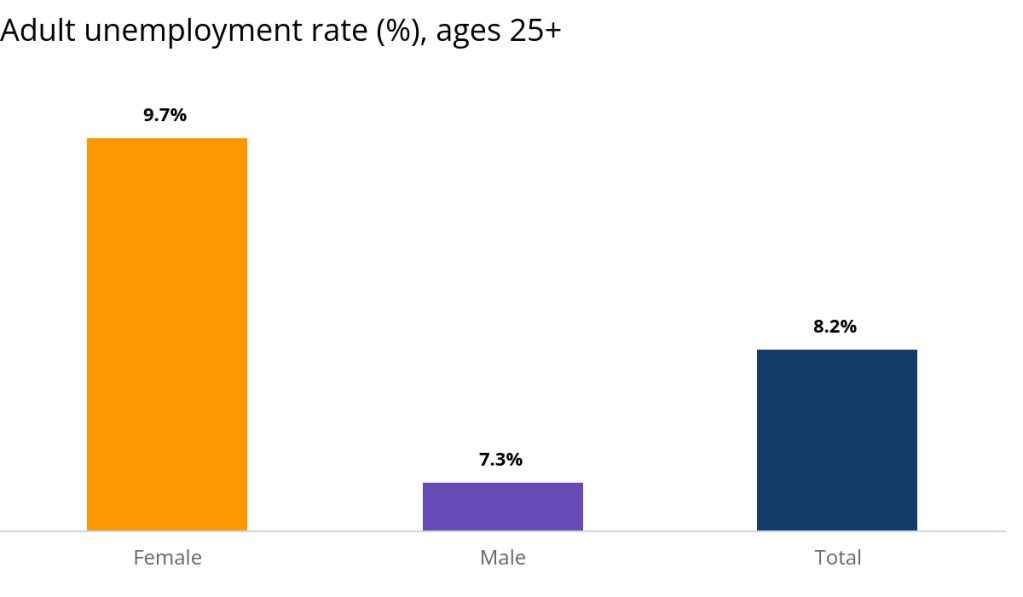
Nepal has to fight with a high unemployment rate, causing many Nepalis to go abroad in search of work. The ban of social media implied that there was a possibility to lose or have less contact with one’s family, which is what many citizens feared. These social concerns mirror a broader economic struggle: data from the World Bank discloses that the unemployment rate in Nepal is at 8.2%. The widely accepted healthy range of unemployment is at a 3-5 % maximum, further undermining the serious economic struggle Nepal is in. The graph above also displays that the adult unemployment for women is even higher than the unemployment for men, at 9.7%. This gap only widens when looking at the youth employment rate, meaning adults under the age of 25. Here, women have to battle a 23.4% unemployment rate, with a 20.5% youth unemployment rate overall.
Looking at the unemployment rate alone, is it surprising that there would be a revolution at some point? Probably not: The struggle to find work and sustain oneself can build up intense frustration.
Why is there so much gender inequality in Nepal’s labor market?
According to a study by UNICEF, “women are trained and expected from childhood to be less active, less visible and less verbal in comparison to men.” Gender stereotypes and norms are embedded into Nepalese society, making it hard for women to separate themselves from them, reflected in difficulties in taking on or being assigned more challenging tasks within jobs that require more responsibility and to not prioritize their role as being the caretaker of their home. The sectors in which the women work also matter: Nepalese men are often overrepresented in sectors that offer more stable formal contracts and provide higher wages. However, for many women these types of jobs are not a given. They often do not have access to equal pay opportunities, safe and sanitary working conditions, and social protection services (World Bank, 2024). Another indicator for the inequality in society is Nepal’s female labor force participation rate in 2024, which was at 28%. In comparison, the female labor force participation rate of the Netherlands in the same year was at 63% and the rate of Bhutan, a similar economically developed country, was calculated to be at 40.1%.
But how exactly did this revolution take place?
The destination of the protest march was Singha Durbar, which is a building housing government ministry offices. Initially, the military reacted to the protests with tear gas and water cannons – a few hours later, they turned to harder ammunition as well. Meanwhile, radicals broke through police barricades and tried to climb up the walls of Singha Durbar, which they failed to do. That is, because the police used rubber bullets. This use of force sent a shockwave through the country.
Direct consequences
On September 8th, the home minister that was responsible for police operations, resigned from his post. Nevertheless, the prime minister, Minister K. P. Oli, did not resign. Unsurprisingly, this led to further riots, including hotels being set on fire. Some politicians were beaten, while others were evacuated by the military before the riots could break through. This behaviour, however, was criticised by important key figures in organizing the protests. Although sources differ, the number of deaths is assumed to be somewhere between 50 to 74.
What exactly can a new government do so that changes in Nepal can be seen?
Fighting corruption is hard, but it is not impossible. As corruption was the main source of frustration within Nepal, a new government in Nepal should implement a stronger legal framework: Although Nepal does have a Commission for the Investigation of Abuse of Authority, in short CIAA, it could benefit from an expanded jurisdiction to cover private sector corruption. The jurisdiction would also need to be protected more strongly from political interference, therefore enhanced investigation powers are needed. Nepal could also benefit from faster criminal proceedings, to ensure quicker action against corrupt officials. To support this, there could be specialized courts. These specialized courts could offer a more effective prosecution, mainly through appointing judges educated in the field of corruption. Nepal could also benefit from a stronger asset recovery: this includes civil forfeiture laws. Civil forfeiture laws ensure that there are legal processes that allow the government to seize property suspected of being connected to criminal activity. That is, even if the property owner is never charged with, or convicted of, a crime (Cornell Law School, 2025). Other useful government policies could be international government cooperation mechanisms, meaning that neighboring countries and Nepal should cooperate more to fight corruption. This is much-needed because of ongoing money-offshoring into other countries. The government could also implement the use of technology to reduce corruption, such as through a digital payment system for government transactions or an AI analysis of government documents. The government documents would be submitted into an AI, for instance in the form of a PDF, and the structure and content could then be analyzed towards any signs of corruption.
Without a doubt, there must be multiple policies and changes made across various sectors, not just one. It is also crucial that the political pressures to do so stay persistent, hence that Generation Z keeps fighting for their goals.
Digital Media
The revolution in Nepal is so special because it sets an example about the new role that social media plays in political mobilization. Protest movements have already existed and been organized via social media prior to the Nepal example, such as in the Arab Spring 2011. What has changed since then though, is that through short-form content such as Instagram Reels or YouTube Shorts, the topic gets even more emotionally charged.
But overall, how successful was the revolution?
It was successful in overturning and replacing Nepal’s standing government in less than a week.
On the 17th of September, Nepal’s interim government declared a national day of mourning for those killed during the Gen Z Revolution, signaling a step towards its citizens. The new interim government is led by Sushila Karki as the Prime Minister. Her main role is to ensure that in March, new elections can take place. Karki had led the Nepalese Supreme Court in the period of 2016-2017 and served as the only woman in the chief of justice. Karki got appointed by the president Pudel, despite the revolutions still in office.. However, she was unofficially voted for at a Discord channel, displaying the influence Generation Z has had on the revolution. Overall, the revolution was successful in creating a new sense of hopefulness for the future: transparency and accountability are finally something that is in reach for the country’s citizens, not just something that is dreamed about. This also inspired movements of protests in the Philippines and Indonesia, in which the citizens fight back against corruption. Furthermore, the appointment of Sushila Karki as the new female prime minister is already a start in the right direction towards more social equality and a milestone of a long process to change deeply- embedded gender roles.
Nepal’s great upcoming challenge will be to not fall back into autocracy and the gradual build up of an undemocratic system. On the one hand, this is a tough challenge because in times of unrest, people will always look up to a strong leader figure, making it easy for said figures to gain power and rebuild the system in the sake of “changing the political issues”. Nepal’s institutions controlling the government are weak and might not be able to fight undemocratic changes in power. On the other hand, what has changed is the digitalization: it is visible through the protests of Generation Z that social media helps to inform, criticize and mobilize, ensuring that the young adults of Nepal will not back down.

Karki in 2025
Bibliography:
Acharya, Sushan. Gender, Jobs and Education: Prospects and Realities in Nepal. Kathmandu: UNESCO Office in Kathmandu, 2014.
AFP. 2025. “Nepal Returns to Calm as First Woman PM Takes Charge.” VnExpress International – Latest News, Business, Travel and Analysis from Vietnam. VnExpress International. September 13, 2025. https://e.vnexpress.net/news/world/nepal-returns-to-calm-as-first-woman-pm-takes-charge-4938627.html?utm.
Cornell Law School. 2017. “Civil Forfeiture.” LII / Legal Information Institute. 2017. https://www.law.cornell.edu/wex/civil_forfeiture.
“Economy | Nepal | World Bank Human Capital.” 2025. World Bank Human Capital. 2025. https://humancapital.worldbank.org/en/economy/NPL?geos=NPL&comparisonBy=SEX.
Franziska Amler, “Nepals Präsident Löst Parlament Auf Und Setzt Neuwahl An,” tagesschau.de, September 13, 2025, https://www.tagesschau.de/ausland/amerika/nepal-neuwahlen-maerz-100.html.
Hussain, Ikram. 2025. “Nepal First Female Prime Minister Takes Charge: What next for Gen Z Protests?” Thenews.com.pk. The News International. September 13, 2025.
“Nepal Appoints First Woman Prime Minister, as UN Expresses Solidarity Amid Crisis,” UN News, September 12, 2025, https://news.un.org/en/story/2025/09/1165839.
Now, Asia. 2025. “Nepal’s Gen Z Revolution: A Foundation to Reform Government? – Association for Asian Studies.” Association for Asian Studies. September 19, 2025. https://www.asianstudies.org/nepals-gen-z-revolution-a-foundation-to-reform-government/.
Peter Hornung, “Was Kommt Nach Den Protesten Der ‘Gen Z’ in Nepal?,” tagesschau.de, September 10, 2025, https://www.tagesschau.de/ausland/asien/nepal-proteste-ausgang-100.html.
Piyush Adhikari, “Nepal’s Leaderless Gen-Z Revolution Has Changed the Rules of Power,” Al Jazeera, October 3, 2025, https://www.aljazeera.com/opinions/2025/10/3/nepals-leaderless-gen-z-revolution-has-changed-the-rules-of-power.
Tessa Wong, “Gen Z Uprising in Asia Shows Social Media Is a Double-edged Sword,” September 24, 2025, https://www.bbc.com/news/articles/cn4ljv39em7o.
Thapa, Kokil. 2025. “How to Understand Why Nepal Cannot Solve the Corruption Problem? | News.” Nepallawyer.com. 2025. https://www.nepallawyer.com/news/how-to-understand-why-nepal-cannot-solve-the-corruption-problem.
Till Fähnders. 2025. “Nepal: Wenn Online-Sperren Eine Revolution Auslösen.” FAZ.NET. Frankfurter Allgemeine Zeitung. September 13, 2025. https://www.faz.net/aktuell/politik/ausland/nepal-wenn-online-sperren-eine-revolution-ausloesen-accg-110683145.html.
Wikipedia Contributors. 2025. “Sushila Karki.” Wikipedia. Wikimedia Foundation. October 8, 2025.
Wong, Tessa. 2025. “The Mass Protests in Asia Show the Power of Gen Z – and Its Limit,” September 23, 2025. https://www.bbc.com/news/articles/cn4ljv39em7o.
“World Bank Open Data.” 2025. World Bank Open Data. 2025. https://data.worldbank.org/indicator/SL.TLF.CACT.FE.ZS?end=2024&locations=NP&start=1990&view=chart.
“World Bank Open Data.” 2025. World Bank Open Data. 2025. https://data.worldbank.org/indicator/SL.TLF.TOTL.FE.ZS?locations=BT.
“196 Injured in Gen Z Protest Still under Care at 32 Hospitals.” 2025. @Kathmandupost. The Kathmandu Post. 2025. https://kathmandupost.com/national/2025/09/19/196-injured-in-gen-z-protest-still-under-care-at-32-hospitals/.
Author: Julia Isabel Schelbusch
 BAISmag