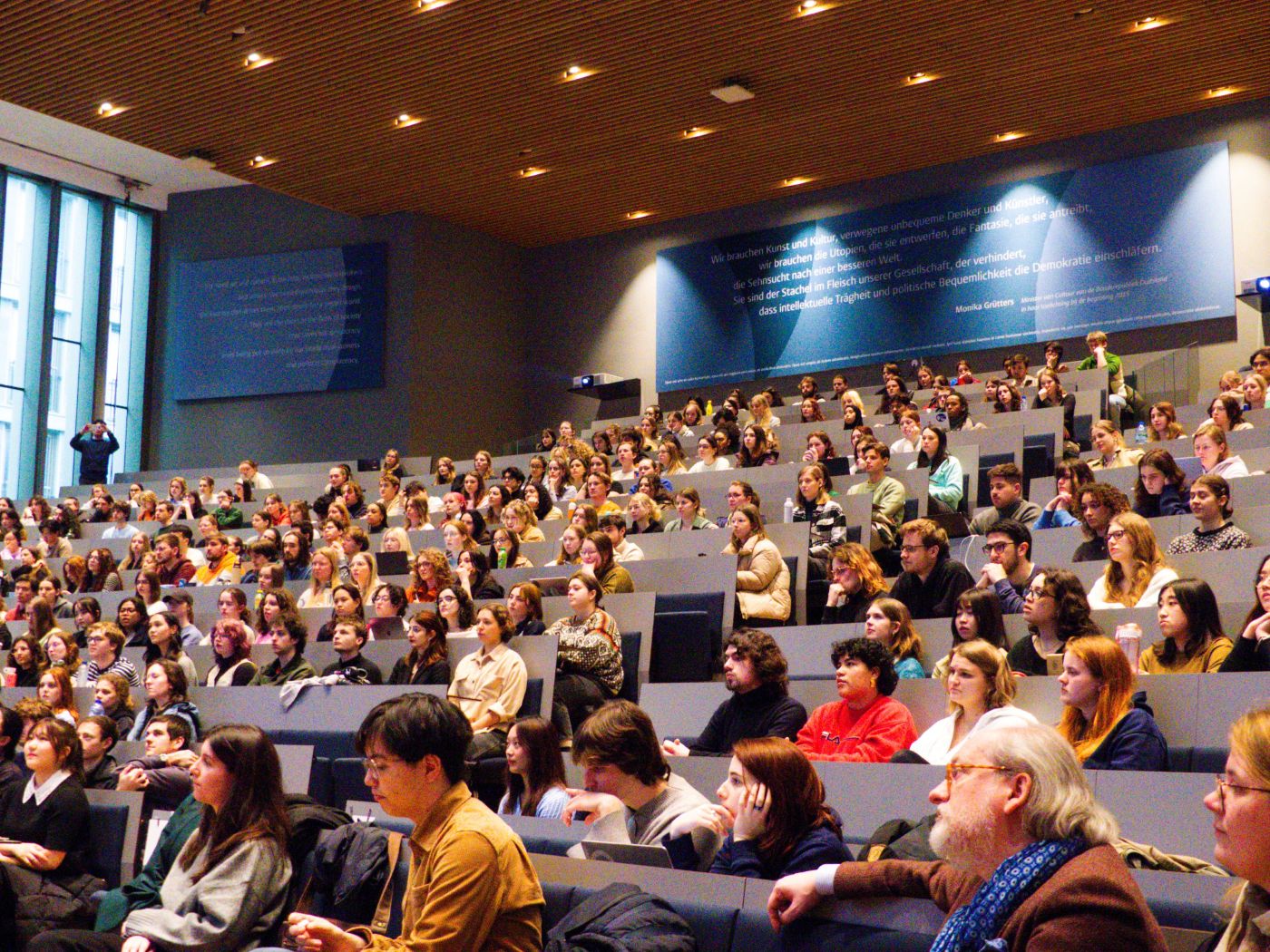
On the 22nd of March BASIS’s East Asia Committee organized a joint event with the NGO PSCORE. During the event students were able to hear a talk about Human Rights Abuses in North Korea, an in-person testimony of Sugyeong Min, a North Korean Defector, accounts of internet freedom in the country, and were able to interact and ask questions with the presenters directly. With 300-370 attendees, the lecture hall was nearly full and the Q&A at the end was by far too short to answer all the students’ questions. The NGO was thus so kind as to provide written responses to the questions that weren’t answered during the event; these can be found attached to this article.
Since its founding in 2006 the NGO “People for Successful COrean REunification,” has been working towards three distinct goals. The first one is ending human rights abuses in North Korea, which the NGO promotes through advocating and spreading awareness. The second goal is empowering North Korean Refugees through organizing education programs. For its third goal the NGO ultimately works towards Korean reunification through its various campaigns (PSCORE 2024).
During their talk, the speakers focused especially on the topic of internet use in North Korea and how internet freedom is connected to human rights. As shown by the PSCORE research report on “Internet Freedom in North Korea” (full copy available in the BASIS office in Wijnhaven), most North Koreans don’t know of the existence of the internet, or only know of it in theory. In comparison, about 65.7% of the World Population uses the internet for an average of 7 hours per day (PSCORE 2024).
During the following account of two North Korean defectors, deeply moving scenes captured the audience. Dressed in all red, Myunghui Ji told the story of her difficult life in North Korea, about the food shortages, the poverty, and how she had to pass over to smuggling across the Chinese border to make a living. Dignified and close to tears, she then recounted her multiple escape attempts, her captures, and the unimaginable torture and abuse she experienced in both, Chinese and North Korean prisons. Finally, she told of her last and ultimately successful escape attempt and how she later risked her life again, going back to North Korea to rescue her two sons. Judong Jin then was connected via Video Call and gave an account of his time in the labor camps and North Korea’s semi-collaboration with Russia.
In the Q&A Myunghui Ji responded to one of the questions that the biggest wish for the rest of her life would be to once again lay eyes upon her hometown. Many more interesting questions were asked and answered despite the temporary communication problem with Judong Jin, but for many more there unfortunately wasn’t enough time. The East Asia Committee thus submitted the remaining questions to the NGO and written responses were given. These responses can be read in the following:
Common Question
1. To both speakers: Even after leaving North Korea for years, is there still a risk of defectors like yourselves being forcibly repatriated?
Myunghui Ji: There is no danger when our North Korean defectors are in South Korea.
However, there is a risk of being kidnapped and forcibly repatriated when we visit communist countries, countries with diplomatic ties with North Korea, especially China, even if we carry South Korean passports. Many North Korean defectors have been forcibly repatriated even though they have South Korean passports.
Judong Jin: Yes, there is. Forced repatriation is a problem North Korean defectors fear for their entire lives when they are in China or Russia. However, they are safe once they enter Korean territory. Of course, forced repatriation took place in Korean territory during Moon Jae In’s presidency, but that never happened before, and it shouldn’t be repeated in the future. Sometimes the North’s State Security Department lures North Korean defectors to China by luring them to their families in the North and kidnap them.
2. Would you talk with neighbors, friends or your children about your plans to defect or where you afraid of being surveilled by the government?
Myunghui Ji: I talked to my best friend, but it’s a matter that must be dealt very cautiously. When I was forced to return to North Korea twice, my sons were too stubborn to oppose the defection, so I couldn’t talk to them and held back tears.
Judong Jin: It is common for all North Korean defectors to not tell their plan to close friends and family because they are afraid of being exposed to the North Korean security department. In my case, my family was not around me at the time and I had close friends, but I couldn’t tell anyone that I was trying to defect.
3. For both: Do you have hope that you will see a better North Korea in your lifetime?
Myunghui Ji: I really hope that North Korea will get better in the future. But it’s going to be a little tough. I don’t think the North’s economy will develop unless it gives up its nuclear weapons, but North Korea will never give up its nuclear weapons
Judong Jin: This is what North Korea is saying now. Kim Il Sung was better than Kim Jong Il and Kim Jong Il was better than Kim Jong Un. There is such old saying that there is no son like a father, and it is not wrong.
In other words, Kim Jong-un currently governs the worst. I can guarantee that the North Korea ruled by Kim Joo-ae(Kim Jong-un’s daughter) will be worse off than it is now. As long as there is a dictatorship, it will be difficult to expect tomorrow.
4. To both: Have you met with other North Korean defectors in South Korea/Russia? What is it like?
Myunghui Ji: I can meet many North Korean defectors in South Korea. I’m always glad to meet people from my hometown
Judong Jin: We meet. When we meet, we suspect each other of us as spies in the security department, and we avoid talking to each other as much as we can.
5. To both: Are there North Koreans you know of that end up regretting their decision to leave North Korea?
Myunghui Ji: I’ve heard that there are people like that sometimes. They usually come to Korea alone or are young men. I think they think that because they are so lonely away from home
Judong Jin: Yes, some do. What they regret is not because of difficulties in life or lack of hope for tomorrow, but because of the family they left behind. Some wonder if it would have been better to starve to death with your family under dictatorship and regret it. It depends on the person.
6. How has the DPRK diaspora, responsible for sending money to their families in the country, adapted to COVID-19 access challenges and ROK crackdowns on remittances?
Myunghui Ji: After Covid-19, It has been much harder to send money to North Korea. It is because that the North Korean authorities have intensively searched for remittance brokers and that remittances are not being made at all due to the severe fraud.
Judong Jin: First, I stopped sending money for the time because it was difficult to send money. But now it is gradually getting better again.
Second, it is a misconception that the South Korean government cracked down on remittances. I know there have been cases where some narrow-minded police have probably argued against brokers, but it is false news that the South Korean government is blocking remittances from North Korean defectors.
7. Is it possible to maintain the integrity of your own human thought within the context of a surveillance state and how important is that to people who live there?
Myunghui Ji: It is difficult to maintain a complete mind in North Korea, and if you are caught by the security department or surveillance agency by any wrong doing or mistake, you and your entire family will suffer, so everyone is always wary of each other and paying attention.
Judong Jin: It is almost impossible. North Koreans are afraid to think badly of Kim Jong-un. They are afraid that their thoughts will be expressed without their knowledge. However, facing up to dictatorship and having the right thinking is very important to them nonetheless, and I think that those of us who enjoy freedom from the outside should help them do so by whatever means possible.
8. For all panelists: Are there any similarities you see between western society and North Korean society in terms of surveillance?
Myunghui Ji: I think it’s a completely different context. If you think of North Korea as a huge prison, it would be easy to understand.
Judong Jin: Of course, it would be the same in terms of surveillance. However, while North Korea’s surveillance serves to annihilate its people for the sake of Kim Jong Un’s personal safety and attainment, the West’s surveillance is aimed at protecting a democratic society and maintaining a capitalist state. Can capitalism and democracy exist without such capitalist regimes as shields?
9. Question to all panelists: What do you think about private enterprise in NK, is that a way people can liberate themselves a little?
Myunghui Ji: Private business is allowed and there are companies that are commissioned by the government, but the way they do business is not free and the government takes a lot of money in the name of tax.
Judong Jin: Although there are private businesses, all of them belong to state agencies, and bribes must be frequently paid to the relevant state powers as taxes. Such individual entrepreneurs should also always be prepared to be able to go to the North Korean State Security Department as traitors in an instant. The State Security Department, which has unprecedented power in North Korea, often accuse individual entrepreneurs as national traitors to concentrate on political prisoners when it needs money, confiscating all of their property, and using it as funds for the operation of the State Security Department or for the privacy of State Security officials.
10. How can the EU help the people of North Korea?
Myunghui Ji: Even if Europe or other NGOs provide a lot of aid, the North Korean government take all and does not give it to individual citizens. Therefore, I think EU cannot provide direct and indirect help to individual North Koreans.
Judong Jin: Thank you. As a North Korean defector, I would like to express my gratitude for your kind question. I hope that EU raise your voice against Kim Jong-un’s dictatorship and provide conditions and environments for North Koreans to defect safely from all parts of the world. Even if they make strange remarks that they like socialism and that Kim Jong-un is good, they are saying this under the constant surveillance of the State Security Department, so please don’t think it badly and please provide them with all the necessary information. Of course, I hope that EU will help North Korean defectors escape from North Korea whenever they want.
11. Approximately how many defectors does PSCORE work with?
– More than 3000. Including interviewees, education program participants, and partner NGOs.
12. How bad was the economic crisis in North Korea? Do people have to eat rats and insects to survive as is often reported?
Myunghui Ji: Many starved to death, and it was hard to learn new ways of survival because the ration was suddenly cut off. It’s a lot better now.
Judong Jin: It is still common in North Korea to eat rats and insects to survive. When you asked how difficult the struggling march was, rumors spread that people ate human meat in many parts of North Korea. It is insane for a person to see others as a lump of meat rather than as a person. However, if you starve a person for a long time like five to six years, that’s what happens. That’s about the level of difficulty.
13. So far, how have South Korean people you came in contact with helped you integrate within the society?
Myunghui Ji: When North Korean defectors enter the country, they provide basic education on Korean society for three to four months and South Korean volunteers help us to experience South Korean society.
Judong Jin: Of course, Korean society is not a society where only good people live. Some Koreans treat, misunderstand, or even try to extort North Korean defectors. However, all the people I have met have done everything they can to help me. I am always grateful to all of them as well as the Korean government for treating me as a member of the people.
14. Do you think a revolt against the North Korean regime is likely at all?
Myunghui Ji: Rebellion cannot happen. Rebellion is difficult due to the decentralization, monitoring, and control of the power elite.
Judong Jin: That sounds difficult. When someone says something that criticizes Kim Jong Un, not only the person who spoke up but also his eighth cousin are sent to prison camps to isolate from the public. This has been done for three generations. Under these circumstances, attempting to revolt is a very difficult task. It is almost like a quintic equation. I think the biggest defiance against dictatorship in North Korea is defection.
15. 탈북 이후 이렇게 저희에게 이야기를 들려주시기 위해서 감사합니다. There is currently a discussion on sanctions and their effectiveness. Is the current sanctions regime an effective method or does it harm North Korean citizens?
Myunghui Ji: While UN sanctions are an effective method, sanctions against the North Korean government do not directly affect the people. I think any strong sanctions will not be effective unless they can block exchanges with China, Russia, etc.
Judong Jin: First, when former President Trump first imposed U.N. sanctions on North Korea, China and Russia responded, making sure it worked. However, now China and Russia are openly cooperating with North Korea in complete disregard of U.N. sanctions on North Korea. I think any sanctions on North Korea that failed to persuade or mobilize China and Russia are meaningless.
Second, you asked if sanctions against North Korea affect North Koreans. All forms of sanctions will only affect Kim Jong Un, and have nothing to do with North Koreans. They will not be able to eat fully anyway. Kim Jong Un will not let them do so. It is the North Korean dictatorship’s ruling theory that they will rebel if they feel comfortable.
16. Do you fear to be traced down and maybe threatened by the North Korean government while living elsewhere now?
Myunghui Ji: There were some such people around. Some people were anxious because the family of a North Korean defector was threatened in North Korea. But that never happened to me.
Judong Jin: I’ve never been tracked down or threatened, but the idea that it could happen are always in the back of my mind.
17. What was the most surprising thing you saw after leaving North Korea and starting your life in Seoul?
Myunghui Ji: The global network, the perfect infrastructure of the Republic of Korea, and furthermore, social welfare still surprises me.
Judong Jin: There is a National Basic Livelihood Security System in Korea. To sum up, the country takes care of people who don’t have jobs. This was the most amazing fact. In other words, Korea is a place where people can eat and live without working. It seemed like a very strange country to me.
18. North Korean defectors have a difficult time assimilating in South Korea sometimes due to discrimination at work and school as they can be targets due to the accent. What can/is done about this?
Myunghui Ji: This problem seems to be an insurmountable barrier for North Korean defectors. Many people are unable to get a job due to language problems, and even if they are, they cannot get out from the frame of strangers. Therefore, it seems that there are many people who are engaged in government-connected jobs.
Judong Jin: First, as I mentioned earlier, South Korea is not just a country where angels live. It’s just one of the developed, well-welfare ordinary capitalist societies. There are criminals, murderers, and fools in it. There are some misunderstandings that Korean society discriminate North Korean defectors due to the spread of unsavory things that happen in contact with unusual people.
Two, just avoiding it. In South Korea, I have been looked down on by others for my inappropriate behavior, but I have never been treated like that because of the way I speak or the fact that I am a North Korean defector. And if I am faced with such a situation in the future, I will just avoid it if I am not in a position to put him away.
19. So far, has South Korea been the place you dreamed about? Is there anything you found hard/easy to accept and live with once you arrived there?
Myunghui Ji: The easy thing is what I can get as much as I tried, and the difficult problem is that my lack of language, knowledge, or competence.
Judong Jin: I had no idea what kind of society South Korea was until I defected. I just thought it was a country that guaranteed individual freedom and followed the U.S. However, South Korea was a society where individual freedom was respected and revered, not a country that followed the U.S. To be honest, it surprised me a lot that South Korea was an independent state that thoroughly acted in accordance with its interests and interests. And it was quite conservative and nationalistic. At least it seemed to me that it was.
20. How does the North Korean regime mobilize the youth? Does it still employ regime controlled youth organizations?
Myunghui Ji: The youth organizations have already been in order for decades. They will continue to maintain and strengthen their organization in the future. Therefore, I believe that individuals—youth—cannot be free from the organization, and that control or pressure will continue.
Judong Jin: In North Korea, at the age of 9 to 10, they are asked to join a youth union by tying a red tie around the neck of children across the country. It also recites an oath to 10-year-olds, pledging to give their lives for Kim Jong-un. From then on, they become slaves of Kim Jong-un. The extension lines are the youth union, General Federation of Trade Unions of Korea, Socialist Women’s Union of Korea, and the Korean Workers’ Party.
21. Do you think the regime is getting stronger or is slowly crumbling over time?
Myunghui Ji: The press and the media seem to only deal with what they lack or what they are bad about North Korea. I think North Korea is growing.
Judong Jin: Socialism is a structure in which the dictator at the pinnacle of the pyramid of society is parasitic on members of society, and this is a system that kills itself over time. However, it takes a long time. The North Korean people have to bear the burden of living a life of slavery. The North Korean military is corrupt, and soldiers who protect planes and tank fuel are secretly selling fuel to avoid starvation. I believe that the North Korean military’s corruption index is the highest in the world.
22. How accurate are Yeonmi Park’s reports about North Korea ? Without undermining her experience but she got accused of spreading incorrect experience.
Myunghui Ji: Park claims that her family was wealthy at first because her father was a member of the Workers’ Party, but half of the North Korean population is a member of the Workers’ Party, and they are not wealthy at all. They do not eat dragonfly, either. For Park, human rights activities and her testimony seem to have focused on promoting herself, not the reality of North Korea. I think her testimony is illogical because it is not her story. Her testimony almost sound like “Pseudologia fantastica”
Judong Jin: In conclusion, everything she says is true.
On the fact that not only Park Yeon-mi but also many people who criticize North Korea are evaluated as not telling the truth, I think we should read the truth behind it. North Korea is a corrupt slave state, but it has state power anyway. Using those powers, North Korea is training hackers to commit state-led illegal activities and threaten South Korea and the United States with nuclear weapons and missiles. There is another invisible North Korean activity. Misleading the press. National investment is made in this. I will leave it up to our imagination how much money can make people lie. I think you can lie to quite a few people. It’s a state-to-individual confrontation. With North Korea’s national investment in Park and other anti-authoritarian human rights activists, Park’s reputation would have completely fallen if what she is saying is not really true. Then, are you really investing in North Korea against the activities of North Korean defectors, including Park Yeon-mi?
When I was in North Korea, a friend of the Central Party’s South Korea division once told me that U.S. dollars laundered for this purpose go out each trunk (60*15*40(cm)) every month in South Korea. Such a poor country is pouring money into the rich country of South Korea. Why?
I think you know better than I do how the money will be spent.
23. Do North Koreans view Kim Jong Un more negatively than his grandfather or father? How did the perceptions of North Koreans regarding their country’s leadership change with each leader?
Myunghui Ji: They don’t think negatively of Kim Jong Un. That’s because as generations change, so does brainwashing.
Judong Jin: Kim Il-sung’s son is Kim Jong-il, and Kim Jong-il’s son is Kim Jong-un. I think everyone knows this. There’s a saying in North Korea. “There’s no son better than father, no brother better than brother.” Currently, it is one of the most used words in North Korea. North Koreans often say, “It wasn’t like this when Kim Il Sung was here.” “It’s getting harder as time goes by.”
In a society like North Korea, we can’t openly curse Kim Jong Un. But right now, he is simply maintaining his country with a reign of terror, in which he promptly kills and announces it. His leadership is the worst. An example is shooting his uncle and brutally killing his half-brother with a chemical weapon. I guarantee you, “There is no son better than father.” When Kim Ju-ae (Kim Jong-un’s 11-year-old daughter) reigns as North Korea’s dictator, North Koreans will bring it up again.
24. How much information on the Kim family is the public exposed to?
Myunghui Ji: I would say that the residents know very little of their information, to the extent that the question “Do you know anything?” is more appropriate. Because everything they show in the media is a lie, and their privacy is classified as a top secret.
Judong Jin: North Koreans have no idea other than the distorted facts promoted by the North Korean regime. It’s been a while since Kim Ju-ae was shown to the media, and there are many North Koreans who don’t even know his name yet. North Korea has never revealed her name to its people. It just introduced him as a “New female genera star.” All we needs to know is that she is a slave owner, so the government is telling us not to try to know anymore.
25. Have you seen the Kdrama “Crash Landing on You”? Do you think this is somewhat of an accurate representation of life in North Korea (although evidently romanticized).
Myunghui Ji: There are quite a few people who call it beautification. In the drama, not all North Korean characters have the charm of the main character. In fact, there are North Koreans who have the personality and charm of the main character
Judong Jin: To be honest, it’s not accurate at all. North Korea in the movie is a paradise in comparison to the real North Korea.
Therefore, North Koreans and North Korean defectors feel sad and disappointed when they watch the movie. They romanticized themselves living in hell in the outside world as if they were living in a world worth living in. However, if the writer had expressed the hellish reality of North Korea, there would have been nothing to write about. Personally, I understand the writer and the director of the movie. It’s a movie. In the real situation in North Korea, the heroine is arrested on the spot, and her family members of the hero go to the prison camp up to their eighth cousin. There is nothing to make a movie.
26. How is the academic education gap many North Koreans have addressed when they start living in South Korea? Do they get classes and can they go to university?
Myunghui Ji: Some students study at academies, but it is a little easier for North Korean defectors to enter the school. As a result, it is very difficult to study and even after graduating from college, they usually have relatively low competency.
Judong Jin: Of course, as soon as North Korean defectors enter Korean society, they wander like a boat stranded by an information typhoon. The reality of Korea, which they encounter after living in an extremely closed society, is an extremely free, extremely highly technical, and highly specialized society. In short, it is mental breakdown. There are only two categories of North Korean defectors’ settlement: someone who decides to engage in simple labor and someone who thinks that they have been reborn and steps in Korea’s academic background one by one from middle school.
In the latter case, with the help of the Korean government and charitable organizations, including Church in Korea, the environment and system are already firmly established in Korea where students can get scholarships when their academic performances are excellent.
27. How does your experience with censorship affect your freedom of consciousness in the West?
Myunghui Ji: In North Korea, no matter where you go, you have to get a certificate, and there are a lot of guard posts on the way. No matter where I went in South Korea, there was no obligation to issue a certificate and I haven’t seen any ID censorship. It really felt like I was in a new world, and I feel pity for friends and brothers in North Korea when I think of this difference.
Judong Jin: Sometimes hardship guide us to luck through them. Life under constant surveillance in North Korea makes most North Korean defectors have a subconscious and defensive sense that their behavior is always exposed to someone.
I don’t know if it affects freedom, but I’ve learned to be careful. But I think it’s a good habit to watch out for behavior and not to make mistakes even in a free society. But I don’t want to thank Kim Jong Un for that.
28. What was your childhood like? Do you get any opportunity at all to peacefully be a child in North Korea?
Myunghui Ji: My childhood was when North Korea had a rationing system and paid salary for work, so I grew up happily with the love of my parents.
29. Do you believe the prison guards and security officers genuinely believe in the regime or do you think they do their job because they are too scared to defect?
Myunghui Ji: There are people who believe in the regime, and I think we have no choice but to be loyal to the regime if we want to survive there. Some people really believe that our country is a good country to live in, because we have only been educated like that without knowing the world. North Korea is educating us that the reason why we live so poor now is because of the U.S. imperialism and the South Korean puppet parties, which raises hate consciousness and blinds the people’s eyes and ears and prevents them from rebelling.
Judong Jin: It’s an act of human instinct to live. Even if prison guards kill man every day, no one thinks they are murderer. They don’t punish them. They are ordinary fathers and sons like us, someone’s lover and husband. They are also afraid of Kim Jong-un. He is the one who kills uncle and brother.
30. What is the comprehension of and opinion toward nuclear weapons by North Korean citizens?
Myunghui Ji: Since we are educated by the North Korean authorities a lot, we think that the U.S. cannot invade our country only when we have nuclear weapons. Some residents think that if we pay only 1% of our defense budget to the people’s lives, we can live well, but we become slaves of the American people
Judong Jin: In short, I think “it’s all money, too”. It is absurd that Kim Jong Un is making such a joke when people are starving to death. But what can I do? They say South Korea and the U.S. are continuing to make armed aggression, but there is nothing I can do even if it is ridiculous.
31. Why is China cooperating to such an extent – torturing and subjecting North Korean defectors to such cruel treatment – with North Korea?
Myunghui Ji: According to the Chinese people, North Korean defectors are lawbreakers and should be sent to North Korea. In my opinion, China brings huge resources at a cheap price from North Korea. North Korea has a lot of resources but not advanced technologically, so it exports resources to China at a cheap price, and imports products processed with those resources at a high price, so I think China will never put North Korea outside of its power.
Judong Jin: It is a political issue that cannot be explained in one word. Nevertheless, to put it simply, it is because Xi Jinping thinks that it is better to have an uncivilized and obedient Kim Jong Un than to have rich Republic of Korea next door.” This is a policy issue that is thoroughly based on careful calculation of the profit relationship between countries, and North Korean defectors and North Korean residents are out of calculation.
32. Do people speak against the regime within families or in private?
Myunghui Ji: Yes, very close people share the criticism of the regime, but not being careful, so the State Security Department, they’re taken to a political prisoner camp.
Judong Jin: North Koreans live their daily lives with the feeling that the State Security Department is constantly eavesdropping on their words. Under such circumstances, we do not openly criticize the regime in any case. As I mentioned earlier, North Korea exterminates up to eight cousins for one wrong word.
Individual Questions for Myunghui Ji
33. Question to Miss Ji: Escaping from your hometown In North Korea certainly wasn’t easy – how did you know how to successfully cross the border?
Myunghui Ji: Yes, it wasn’t easy, I had a lot of fear after being forcibly repatriated twice.
However, knowing the reality of the regime, I didn’t want to let my children live in this living hell. I thought it would be better to die if I was caught this time because I was not confident of enduring the torture if I was caught again and sent back to the North, and I left with poison to eat if I was caught. The Korean church that had brought us in had a powerful broker, and we had to pay him more.
34. Question to Miss Ji: What did you know about the outside world before escaping?
Myunghui Ji: I didn’t know that well. I just listened to Free Asia broadcasts a few times, I met Korean missionaries during the first defection, and I read a few books by North Korean defectors published at Korea.
35. Question for Miss Ji: After your escape, were your family and friends punished? How did you manage to help your children defect with you three years later?
Myunghui Ji: Yes. After I defected, my second son was discharged from the military after 15 days of serving in a security unit, and my oldest son was left in the military as a hostage because he could run away to me if he sent him home. For nearly two and a half years, my sons have lived under a lot of supervision and control. When I sent money back home to bribe the judges so they could feel safe, my eldest son crossed the Yalu River in the evening on his vacation. I took the money and went all the way to China to pick him up.
36. You mentioned you and your sons did mandatory service in the North Korean military. What was your and their experience there?
Myunghui Ji: In North Korea, it is said that serving in the military is a sacred duty of citizens. In addition, it is said that it is easy to join the Worker’s Party of North Korea only after serving in the military, and it is often shown as the signature of executives. We devoted our youth to the country, but we were all deceived by the government. One experience was that I believe the Kim regime taught me well about the spirit of self-reliance. I learned the spirit to live on my own even if I put left on a stone
37. For Myung-hui: What do you think of tourists who visit North Korea? Do you think this practice can have any benefits for opening up North Koreans to the outside world?
Myunghui Ji: I don’t think so, North Korea only allows tourists to see what they set up, so tourist might tour nature. But I think everything is used as propaganda, and all the actual content will be hidden away and you won’t be able to hear it, and you’ll just make them money.
38. To Myeonghui Ji, I want to start by thanking you for sharing your story. I highly appreciate your courage. My question is, how do you view South Korea’s conservative policies towards unification?
Myunghui Ji: Until now, the left has been fooled by North Korea’s rhetoric and given away a lot of money for sunshine policy, but it has not taken a single step forward on the path to reunification, and has provided only time and funds for the North to build nuclear weapons. Of course, the answer is not 100 percent correct despite the conservative unification policy, but as I said in North Korea, I think peace will never be achieved by begging. I think reunification will one day be possible only if we have an independent line and a defense of self-defense. North Korea has no intention of giving up its nuclear weapons and has a firm will to unify the country by absorption in its own way. Therefore, I am rather in favor of the conservative policy.
39. After repatriation, did others believe the stories you told about the horrors you faced? Thank you so much for speaking here today.
Myunghui Ji: There were people who believed my story and there were people who had questions. I, too, would not have believed it if it were someone else’s. My close friends were shocked to see the torture marks on my legs.
Thank you very much for listening to our testimony so far, for many young people attending and paying attention to human rights in North Korea.
Individual Questions for Judong Jin
40. Why did you decide to work overseas? Did you back then already envision leaving North Korea?
Judong Jin: No. When I was in North Korea, I was a key member of Kim Jong-un or the North Korean regime. It’s not because of ideology, but because that’s how I could live better than others. I came here to live better abroad. However, at a time when Kim Jong-un’s increasing exploitation of the state and corruption of his executives made it impossible to predict the future, I defected because I thought it was the duty of Koreans to exterminate such an autocratic state and slave society.
41. For Ju-Dong Jin: Are North Koreans who are sent to Russia as labourers able to speak russian? Do they learn it there? Are they able to escape without knowing Russian?Judong Jin: Most of them speak Russian. I learned it in Russia. Even if they don’t speak Russian, they can defect if they know the route.
– Elisabeth Schmidt and the BASIS’s East Asia Committee
Image: Yamal van Oordt, BASIS
 BAISmag