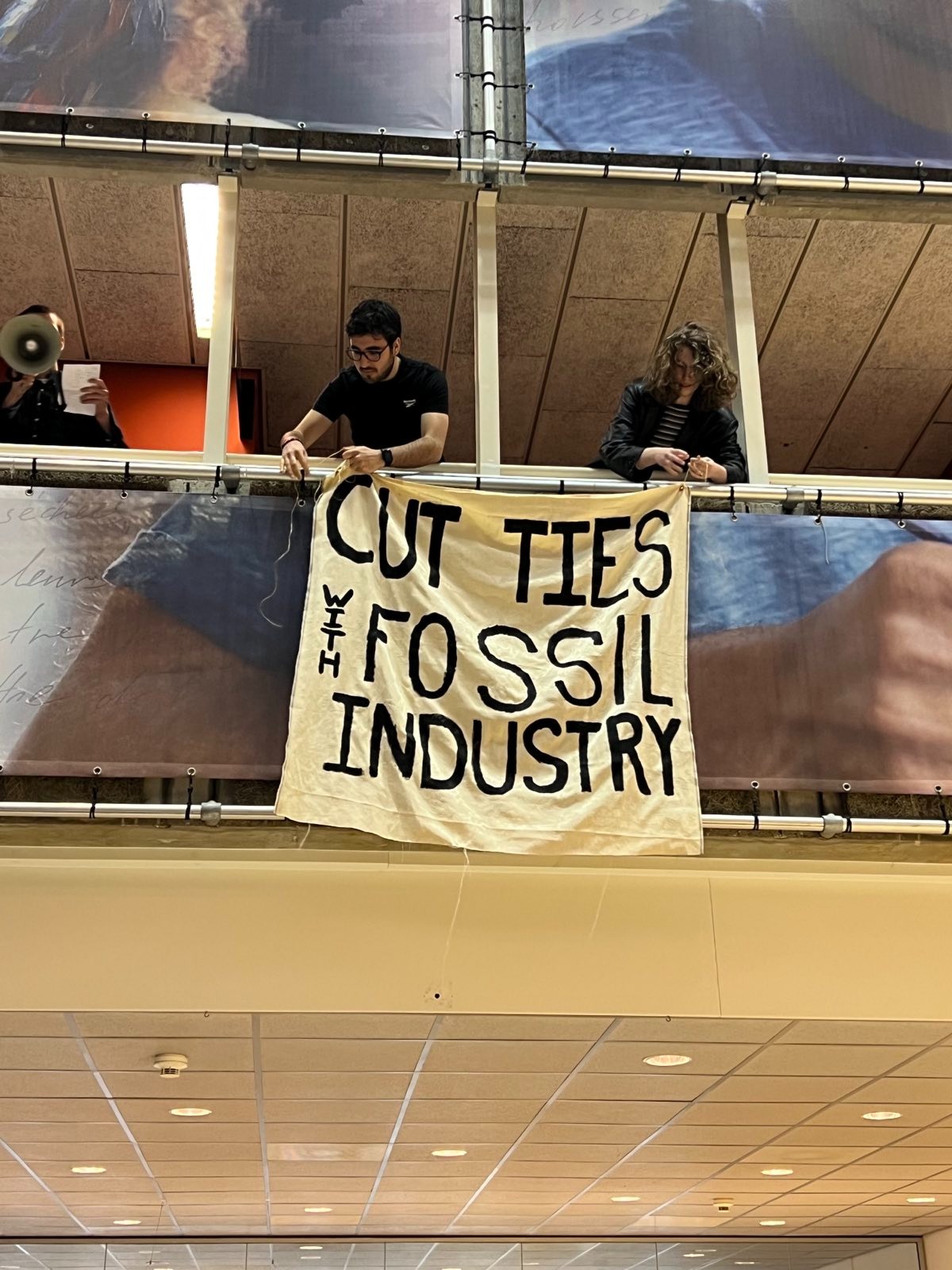
Leiden, September 27.
In front of a crowd composed of both staff and students, Hester Bijl (Rector Magnificus of Leiden University) and Annetje Ottow (President of the Executive Board) were handed the microphone. “Listening closely” in order to “balance all the arguments” is how they described their ambition for the debate, which was more than twice as big as the second largest debate to ever be hosted by a Dutch university. If the debate on fossil fuel was restricted to the lecture hall in which this event was hosted, this would have been a simple task. During the debate of two hours, few different opinions were voiced. Out of the estimated 600 attendees, only a handful of individuals argued that there are at least some benefits to ties with the fossil fuel industry. For the opinions of those who did not get the microphone, a poll was launched through Wooclap. Out of the hundreds of attendees who voted through this poll, only seven voted ‘Yes’ on the question whether they were in favour of unconditional ties with the fossil fuel industry. The remainder of the 2 hours seemed more like – as moderator Roderik van Grieken put it – a party conference: As the microphone went around the room, student after student voiced their opposition against university ties with the fossil fuel industry. Eventually the moderator asked only those with an opinion different from the one already voiced remain standing. A few people kept standing after this request, but a debate was not ignited: “well, I don’t actually disagree with what was said before, but I want to add…” is what one speaker said when given the microphone. Similar words were said by others.
By vote, the lecture hall was nearly unanimously in favour of cutting ties with the fossil fuel industry. However, when looking at the course of debate, one side was not dominant over the other. As most seemed to be more intent on voicing their opinion than sharing arguments in favour of their viewpoint, few actual arguments were presented. As a result, the event seemed more like a demonstration than a debate. Speakers used their speaking time as an opportunity to voice their opinion, rather than to provide arguments supporting those opinions, and speakers were frequently interrupted by people in the crowd.
On the website, the university writes that “the Executive Board first wants to find out how students and staff are thinking about this issue”. However, given the lack of diversity in terms of faculty representation in the lecture hall, it is unlikely that the Executive Board got an accurate insight in what students generally think about the ties: a noteworthy number of students who were handed the microphone mentioned that they were LUC students, and a majority of speakers where humanities students. Few students from the faculty of science spoke, and other faculties, such as the Faculty of Law, appeared to have no representation.
Ties between the university and the fossil fuel industry are, as the debate as well as a series of protests show, not uncontroversial.
In a document published by the University after protests during the Dies Natalis – the university’s anniversary – the university’s partnerships with the fossil fuel industry were listed. While most cooperation between the university and fossil fuel companies entails research on matters such as renewable energy, replacing fossil fuels, and carbon recycling, one tie did not relate to research on anything remotely related to fossil fuel:
Leiden university received a one-time donation of 100.000 USD from a company called Aramco Overseas, part of Saudi Aramco. The majority of shares of this oil company are owned by the state of Saudi Arabia. While most speakers at the discussion focussed on the negative effects the fossil fuel industry has on the climate, ethical concerns about Saudi Aramco were not mentioned: the Saudi government is often criticized by various human rights organizations, for a variety of serious human rights abuses. Aside from neglect of women’s rights and absence of lgbtqia+ rights, freedom of speech and freedom of religion in the country, the state is also accused of mass killing of refugees from Ethiopia and the infamous murder and dismemberment of journalist Jamal Kashoggi, as well as various other incidents. The money Leiden University received from Aramco Overseas was intended “for research and outreach in the field of Arabic history and culture” and “among others, to organise a series of lectures and a culture market.”
The university did not seem particularly bothered by the scarcity of disagreement in the lecture hall: Afterwards, a post on the university´s LinkedIn page described the event as “a passionate, two hour long debate” where “opinions were divided.”
– Diederik
.
.
Private image
Find us on Instagram @basis.baismag
 BAISmag